


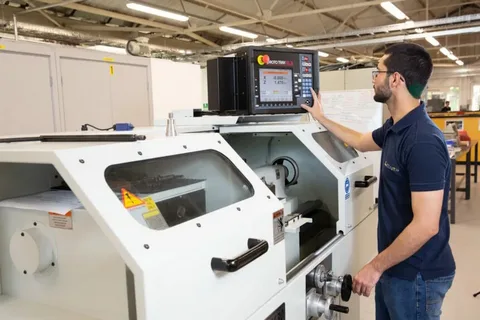
Modern aerospace parts demand more than standard production skills—these components require precision, repeatability and high-integrity practices. For aerospace builds, a CNC machine company must go beyond basic machining services near me or a CNC plasma cutting machine focused on lower-stress materials. The right provider shows deep capability in handling complex alloys for flight-critical use.
Proven Handling of Heat-resistant Metals Common to Aerospace Builds
A machine shop must show consistent experience with heat-resistant alloys such as titanium and nickel-based superalloys. These materials maintain strength at elevated temperatures and are widely used in aerospace structures and engines. A provider that routinely works with them will understand the unique challenges—such as workhardening, chip formation, and tool wear—that standard materials do not present.
In this context, it isn’t enough simply to list alloys in a brochure. The provider should demonstrate documented setups, optimized toolpaths, and process history that prove they can maintain integrity of these materials. Choosing a CNC machine shop near me that claims aerospace experience requires verification of that experience with heat-resistant metals.
Stable Machining Control That Protects Alloy Structure During Fabrication
Machining aerospace alloys must maintain microstructure, avoid thermal damage and preserve fatigue and corrosion resistance. A CNC machine company needs tight control over feeds, speeds, cooling, and vibration management. A tool that meets tolerance but induces heat spikes can compromise alloy behavior under load.
Therefore, the shop should detail how it monitors and adjusts conditions during processing. CNC services near me should include documentation showing stability across the build, minimal tool deflection, and validated process parameters that ensure alloy structure remains intact.
Documented Tooling Practices Tailored for High-strength Aerospace Materials
Effective tooling is critical when cutting high-strength aerospace alloys. Standard end-mills or turning tools won’t last or perform reliably under these conditions. A credible provider will have tooling strategies designed for titanium, Inconel, or other superalloys—with coatings, geometries, and tool life considerations.
The company should also retain records of tool life, wear patterns, and change intervals. Companies offering CNC machining near me often highlight tooling broadly—but for aerospace work the claim must include documented tooling practices and analysis specific to high-strength materials.
Reliable Chip Management That Prevents Surface Flaws on Critical Parts
Chip formation in aerospace alloys is different—long, stringy chips or built-up edge phenomena can easily damage a surface or interrupt a process. A CNC plasma cutter might struggle with this, but a CNC machining company must show how it controls chips, evacuates them, and prevents re-cutting or gouging.
For aerospace applications, the shop should display systems for chip control—like tailored coolant flow, chip removal paths, and containment. The best CNC companies demonstrate how their chip management strategy mitigates risk of surface flaws, scratches or micro-indentations on mission-critical components.
Consistent Dimensional Accuracy Maintained Across Demanding Alloys
Tight tolerances are standard in aerospace. But when the material is demanding, maintaining accuracy through machining becomes harder. A CNC machine shop needs to show evidence of repeatability across runs, regardless of alloy. Measurement data, capability studies, and statistical process control should underpin claims of precision.
Rather than simply stating “high precision,” the provider should offer real metrics: what tolerances they hold (for example ±0.001″ or better), how they validate across material types, and how they maintain stability during long production cycles. Precision counts even more when material costs and certification demands are high.
Mature Inspection Routines That Verify Every Feature Meets Flight-grade Demands
Inspection for aerospace alloys must be rigorous. A CNC services near me provider must have in-house inspections, coordinate measuring machines (CMM), and documented routines that reflect aerospace standards not just general manufacturing. The shop should operate under quality systems such as AS9100 Rev D for aviation, space and defense manufacturing.
Inspection routines should cover dimensional accuracy, surface finish, material integrity (microstructure checks), and full traceability of each feature. The provider should show how these inspections integrate with the process flow so that non-compliant parts are detected early rather than at final test.
Dependable Coolant Strategies That Safeguard Alloy Integrity Under Load
Coolant becomes unusually important when machining aerospace alloys because of thermal sensitivity, risk of micro-cracks, and alloy distortion. A CNC plasma cutter may use different cooling regimes, but for aerospace machining the company must use coolant strategies designed for superalloys: high pressure flushing, biphase or staged coolant, and appropriate filtration systems.
The provider should describe how coolant is selected, maintained, and monitored. It is not enough to say “we use coolant.” Instead, there should be a documented coolant system with filters, contamination control and data on how the process preserves alloy integrity under the stresses of machining.
Clear Traceability Systems That Track Each Step of the Machining Process
A CNC machining near me provider working in aerospace must show traceability: from raw material batch, heat-treatment verification, tooling logs, machining passes, inspection records, to final shipping. Without traceability each inspection or approval is weaker. The shop should provide a documented system where each step is recorded and available for audit.
This is more than a spreadsheet. It involves labeling, serialization, process flow mapping and digital records that link raw material certification, machining parameters, tooling usage and post-machining processes. When you ask about it, the provider should show how they build traceability into their workflow and deliver documentation accordingly.
Demonstrated Experience Producing Components That Withstand Extreme Operating Conditions
Finally, aerospace parts must perform in extreme conditions: high temperature, high pressure, radical vibration, and long service lives. A CNC machine company must show sample components produced for aerospace, defense or space applications—not just automotive brackets. At the very least, they should document the industries supported and material types processed.
Saying “we serve aerospace” means little unless the company provides evidence: parts flown on aircraft, qualified supplier status, certifications like ITAR compliance or AS9100 registration. When that evidence is there, the claim becomes credible.
Choosing a CNC machine shop is not about finding any provider that offers “CNC services near me” or “CNC plasma cutting machine” options—it’s about finding one with the documented depth to handle aerospace alloy demands. At the end of the day, a provider such as Amtec Solutions Group offers precision CNC machining, high-strength material processing, AS9100 Rev D certification, and full traceability—making them a solid partner when aerospace performance is non-negotiable.
